
Jean-Michel Jarre: The French Icon Who Invented Modern Electronic Sound From a Paris Apartment
No record label believed in it. No studio would host it. So he built the future of music between his kitchen and his living room.

Jean-Michel Jarre: half a century after Oxygene, still the reference point for electronic music worldwide.
Overview
Who Is Jean-Michel Jarre?
Jean-Michel Jarre (born August 24, 1948, in Lyon) is a French composer, performer and record producer universally recognized as one of the founding fathers of modern electronic music. With more than 80 million albums sold, four Guinness world records for concert attendance, and a catalog that stretches from 1976’s revolutionary Oxygene to 2022’s acclaimed Oxymore, no artist has done more to take synthesizer music from the laboratory to the world stage.
His story contains multitudes: the son of legendary film composer Maurice Jarre (Lawrence of Arabia, Doctor Zhivago), a student of musique concrete inventor Pierre Schaeffer, the first Western musician to perform in Communist China, a UNESCO goodwill ambassador, and the man who played to 3.5 million people in a single night in Moscow, still the largest audience for an outdoor concert in history.
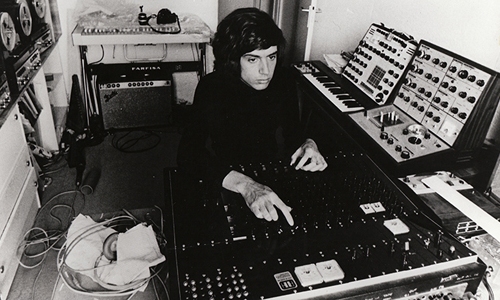
And it all began not in a great studio or a concert hall, but in a makeshift setup squeezed into his Paris apartment, where a 28-year-old with borrowed and secondhand synthesizers recorded the album that made electronic music a global language.
Origins
The Roots: Lyon, Paris and Pierre Schaeffer’s Laboratory
Jean-Michel Jarre was born in Lyon in 1948. His father, Maurice Jarre, left for Hollywood when Jean-Michel was a child and went on to win three Academy Awards for his film scores. The distance between father and son became one of the quiet engines of Jean-Michel’s ambition: he would build his own musical universe, on his own terms, with instruments his father’s orchestras had never imagined.
In Paris, after playing in bands and studying at the Conservatoire, Jarre joined the Groupe de Recherches Musicales (GRM) in 1969, the legendary research center founded by Pierre Schaeffer, the inventor of musique concrete. There he absorbed the radical idea that any sound could be music, and got his hands on the primitive synthesizers and tape machines that would define his art. The influence of Schaeffer’s methods runs through everything Jarre ever recorded, from tape effects to the sculpting of pure electronic texture.
Through the early 1970s Jarre wrote for other artists, composed for ballet, advertising and film, and released early experimental work. But the industry saw electronic music as a novelty. What came next proved the industry catastrophically wrong.
The Big Bang
Oxygene: The Album Recorded in an Apartment
Between August and November 1976, Jarre set up a makeshift studio in his Paris apartment and recorded a six-part suite of instrumental electronic music with no drums played by human hands, no guitars, no vocals and no famous guests. His arsenal: an ARP synthesizer, an EMS VCS 3 and AKS, an RMI harmonic synthesizer, Farfisa and Eminent organs, a Mellotron and a primitive rhythm machine, with engineer Michel Geiss helping him source and program some of the instruments.
Record labels rejected it. Too long, no singles, no singer, no future. Finally the small label Disques Motors released Oxygene in France in December 1976, wrapped in Michel Granger’s unforgettable cover painting of the Earth peeling open to reveal a skull.
The album became a phenomenon. It reached number 2 on the UK charts, spread across the world through Polydor in 1977, and went on to sell an estimated 12 million copies, becoming the best-selling French album of all time. The single “Oxygene Part IV,” released in January 1977, turned a hypnotic synthesizer melody into one of the most recognizable pieces of music of the century.

“Oxygene Pt. 4”: the melody that carried electronic music from a Paris apartment to the entire planet.
The Sound
The Sound That Changed Everything
What made Oxygene revolutionary was not the technology. Others had synthesizers. It was the humanity Jarre poured through the machines. Where German pioneers like Kraftwerk leaned into automation and robotic precision, Jarre composed atmosphere: warm, tidal, emotional music in which arpeggios drift like currents and melodies hang between melancholy and wonder.
He followed the same path on Equinoxe (1978), again recorded in his apartment studio, this time on a 16-track machine, conceived as the journey of a single day from waking to sleep. Then came Les Chants Magnetiques (1981), the sample-driven avant-pop of Zoolook (1984), which won the Grand Prix du Disque of the Academie Charles Cros, and the space-age grandeur of Rendez-Vous (1986).
Across five decades, Jarre never stopped renewing the vocabulary of electronic music: ambient, new age, synth-pop, techno collaborations, immersive 3D audio. The through line is always the same: technology in the service of emotion, never the other way around.
The Spectacle
The Concerts: Four Guinness World Records
If Oxygene made Jarre famous, his concerts made him mythical. He essentially invented the modern outdoor mega-spectacle: free, city-scale events fusing music with lasers, projections, fireworks and architecture, staged on monuments and skylines rather than in stadiums.
Along the way he lit up the pyramids of Giza for the millennium, played the Eiffel Tower, the Sahara and the Dead Sea, and performed for Pope John Paul II’s visit to his native Lyon in 1986 before 800,000 people. Even the sky is his: minor planet 4422 Jarre is named in his honor.
The Wall Breaker
China 1981: Breaking the Wall With Synthesizers
In October 1981, Jarre achieved something no rock star, no diplomat and no label had managed: he became the first Western musician officially invited to perform in the People’s Republic of China after the Cultural Revolution. Over five concerts in Beijing and Shanghai, more than 120,000 Chinese listeners heard Western electronic music live for the first time.
The resulting live album, Les Concerts en Chine (1982), documented one of the great cultural exchanges of the Cold War era. For a generation of Chinese musicians and listeners, Jarre’s synthesizers were the sound of an opening world. Beijing’s Conservatory of Music made him an honorary member.
The showman at work: Jarre turned the concert itself into an art form of light, architecture and sound.
2022 – 2026
Jarre in 2026: Oxymore, Brutalism and 50 Years of Oxygene
At an age when most legends settle into greatest-hits tours, Jarre keeps pushing the frontier. His 2022 album Oxymore, conceived as a tribute to the late French composer Pierre Henry, was built for 360-degree spatial audio and hailed as some of the most adventurous music of his career. Its lead single “Brutalism” proved that the 70-something pioneer could still make the dance floor and the avant-garde meet.

“BRUTALISM”: Jarre in the 2020s, as radical as ever, bridging techno energy and concrete architecture in sound.
The live machine keeps rolling too. On November 1, 2025, he staged a spectacular at Registan Square in Samarkand, Uzbekistan, and his 2026 European tour includes major dates in Athens, Madrid and Amsterdam, with setlists spanning from Oxygene to Brutalism. Meanwhile, a remastered 40th anniversary edition of Zoolook arrived for collectors, and the music world marks a monumental milestone: 2026 is the 50th anniversary of Oxygene, the apartment-born album that started it all.
The Verdict
Legacy: The Father of Modern Electronic Music
Every era of electronic music carries Jarre’s fingerprints. The ambient movement learned atmosphere from him. Synth-pop learned melody. The EDM era learned spectacle: every festival main stage with its lasers and pyrotechnics is running a playbook Jarre wrote at Place de la Concorde in 1979. And the bedroom-producer revolution, millions of artists recording world-class music at home, is living proof of the Oxygene principle: the room does not matter, the vision does.
“He has ingratiated himself into popular culture in a way that no other ambient producer, except for maybe Brian Eno, has achieved.”
Songkick, on Jarre’s towering influenceA UNESCO goodwill ambassador, a longtime defender of artists’ rights, a restless collaborator who has worked with everyone from techno’s elite to classical orchestras, Jean-Michel Jarre remains the standard against which electronic ambition is measured. Fifty years after a young Frenchman ran cables across his apartment floor, the sound he invented is simply the sound of the modern world.
Discography
Jean-Michel Jarre: Essential Albums
Oxygene
Electronic · Ambient · Space Music
The apartment-recorded masterpiece that changed music history. An estimated 12 million copies sold, the best-selling French album of all time.
The essential starting point
Equinoxe
Electronic · Ambient
A day in a human life told in synthesizers, again recorded at home. Deeper, stormier and for many fans even better than its predecessor.
Home to the beloved Equinoxe 4
Les Chants Magnetiques
Synth-Pop · Electronic
Brighter and more rhythmic, powered by early digital sampling. Its opening suite remains a fixture of his concerts to this day.
Zoolook
Avant-Pop · Sampling
A radical collage of human voices in dozens of languages transformed into instruments. Reissued in a remastered 40th anniversary edition.
Grand Prix du Disque, Academie Charles Cros
Rendez-Vous
Symphonic Electronic
The soundtrack of his Houston and Lyon mega-concerts, including the poignant Ron’s Piece honoring Challenger astronaut Ron McNair.
Oxymore
Electronic · Spatial Audio
His tribute to Pierre Henry, composed for 360-degree sound and featuring the single Brutalism. Proof that the pioneer never stopped pioneering.
His boldest late-career statement
FAQ
Everything You Need to Know About Jean-Michel Jarre
Who is Jean-Michel Jarre?
Was Oxygene really recorded in an apartment?
What is the biggest concert Jean-Michel Jarre ever played?
Was he really the first Western musician to play in China?
What is Jean-Michel Jarre’s most famous song?
Who was Jean-Michel Jarre’s father?
What did Jean-Michel Jarre study with Pierre Schaeffer?
Is Jean-Michel Jarre still active in 2026?
Explore More
Discover More French Music
Share This