
Colette Magny: The Blues Singer French Television Tried to Erase
One hit in 1963. Then the microphones went silent. This is the story of France’s first protest singer and the censorship that buried her.
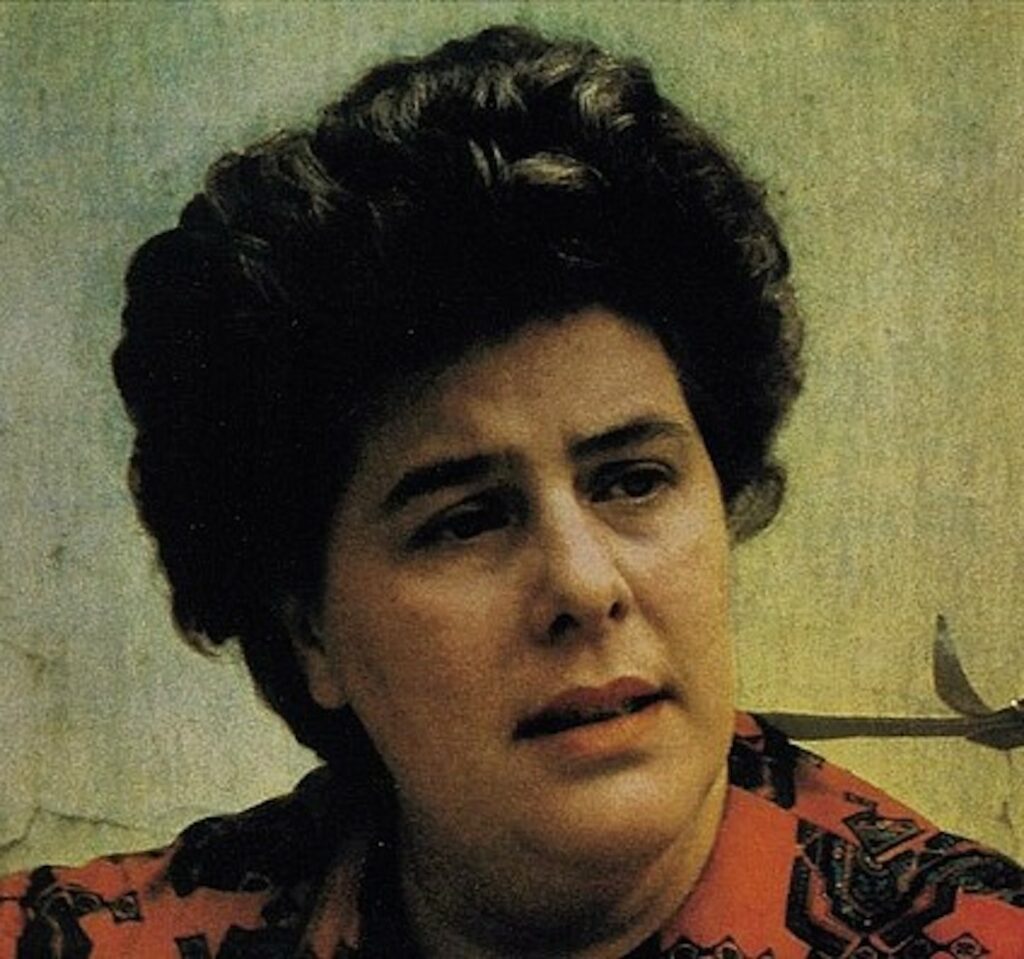
Colette Magny: the voice French broadcasting could not tolerate and could not silence.
Overview
Who Was Colette Magny?
Colette Magny (born October 31, 1926, Paris; died June 12, 1997) was a French singer and songwriter whose work encompassed blues, jazz, protest songs, experimental music and spoken word. With her deep, powerful voice and imposing presence, she was marketed early on as a “French Bessie Smith.” She refused the label, just as she refused nearly everything the French music industry asked of her.
Her story is one of the most dramatic in French music: a secretary who quit her desk job at 36, scored a national hit within a year, and then watched the entire apparatus of French media close its doors on her because she would not stop singing about strikes, racism, colonialism and revolution. Her song “Le mal du vivre” was banned by ORTF, the French state broadcasting network, marking her out as France’s first protest singer.
She spent the following three decades recording fearless, uncompromising music for whoever would listen, winning the prestigious Grand Prix du Disque along the way, while remaining almost invisible on French radio and television. Today, sampled by Orelsan, covered by Axelle Red and celebrated by critics as one of the most original voices France ever produced, Colette Magny is finally getting the recognition the system denied her in life.
Origins
Before the Music: 17 Years Behind a Desk
Nothing about Colette Magny’s early life suggested stardom. Born in Paris in 1926 to a mother who later took up acting, she went to work in 1948 as a secretary and translator at the OECD, the Organisation for Economic Co-operation and Development, where she stayed for 17 years. Fluent in English, she fell in love with the American blues and jazz records of Bessie Smith, Billie Holiday and Ella Fitzgerald, and learned guitar with jazz musician Claude Luter.
By night she began singing her own songs and blues standards in Paris clubs, making her first recordings in 1958 on an album by trumpeter Gilles Thibaut. In 1962, after a residency at the Contrescarpe cabaret in Paris, she made the decision that changed everything: at age 36, she quit her stable international job to become a singer.
Within a year, the gamble paid off spectacularly. And then it cost her everything.
The Hit
Melocoton: The Hit That Became a Cage
In 1963, the singer Mireille featured Magny on her hugely popular television show Le Petit Conservatoire de la Chanson. She performed the blues standard “Saint James Infirmary” and her own French song “Melocoton.” The reviews were rapturous. CBS Records signed her immediately.
“Melocoton,” recorded with the American blues guitarist Mickey Baker, is a gentle, hypnotic nursery rhyme about two children in a garden: little Boule d’or endlessly asking questions about the family, and his older sibling Melocoton answering every time with the same shrugging refrain. It charted on the Salut les copains hit-parade and earned Magny the opening slot for Sylvie Vartan at the Olympia, where her tender song unexpectedly seduced an audience that had come for yeye pop.
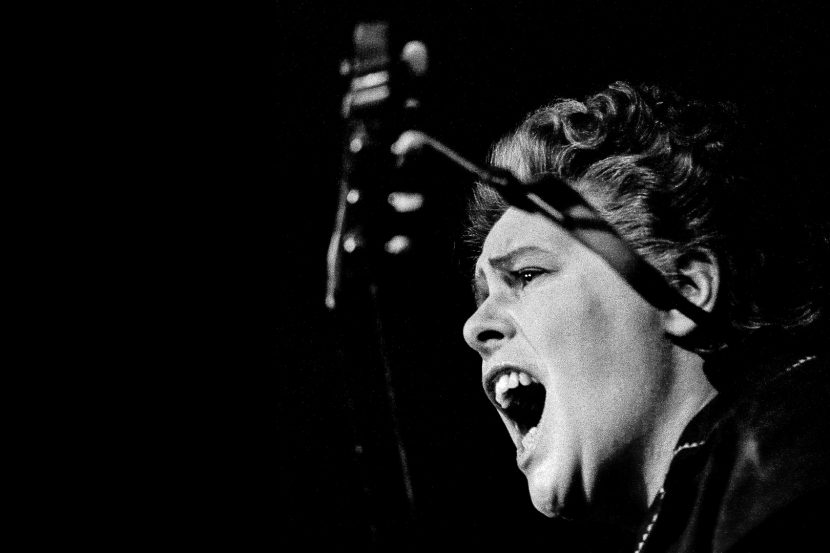
Magny on stage: a blues voice with no equivalent in the French chanson of her era.
But the woman who sang Bessie Smith and set Victor Hugo to music was ashamed of her innocent hit. She felt it did not represent her, and she banished it from her repertoire for 14 years with a phrase that says everything about who she was:
“I decided that Melocoton was dead, that he had gone off to Vietnam.”
Colette Magny, on refusing to perform her only hitThe Villain
The Censorship: How the System Buried Her
What happened next is the heart of this story. Instead of building on her hit with more radio-friendly material, Magny turned her microphone toward everything French society preferred not to hear: the condition of workers, racism, the wars of decolonization, and the poor. In 1963, the same year as her hit, she dared to record songs like “Viva Cuba” and “Choisis ton opium.”
The response from the industry was swift and brutal.
Dropped by CBS
CBS wanted no more of what it saw as a “communist singer.” Her refusal to make concessions and her turn toward what she called “chronicle songs” ended her major label career almost as soon as it began. She moved to Le Chant du Monde, a label close to the Communist Party, and later became her own producer through the association Production Colette Magny Promotion.
Banned by ORTF
Her song “Le mal du vivre” was banned outright by ORTF, the state monopoly that controlled all French radio and television. In a country where one bureaucracy decided what the nation heard, that ban amounted to professional erasure. Throughout her career, she was repeatedly censored on radio and television for her openly leftist positions.
She did not bend. She kept singing at strikes, at benefit concerts, at the Fete de l’Humanite, in every militant hall that would have her, defining herself as an anarchist and proudly anti music industry. As she famously placed herself in the family tree of French rebel song:
“In the punch-throwing family, Ferre is the father, Ribeiro the daughter, Lavilliers the son. And me, the mother!”
Colette MagnyThe Fight
The Resistance Years: Mai 68, Black Panthers and Free Jazz
Locked out of the mainstream, Magny made the underground her kingdom. During the events of May 1968, she actively supported students and workers at sit-ins and benefit concerts, wrote the song “Les militants” for the protesters, and later released the spoken word album Magny 68/69, one of the most striking musical documents of that revolutionary moment.
The early 1970s produced her most celebrated work. Feu et rythme (1970) won the Grand Prix du Disque from the Academie Charles Cros, one of the highest honors in French music, awarded to an artist the media establishment refused to play. Repression (1972) confronted censorship head on and expressed support for the Black Panther movement, whose hymn she sang. Transit (1975) plunged into free jazz with saxophonist Maurice Merle.

“Repression / Exil” (1972), preserved in the RTS archives: Magny confronting censorship in song while the French airwaves refused to broadcast her.
Along the way she collaborated with the cream of French jazz experimentation: Michel Portal, Francois Tusques, Beb Guerin, Barre Phillips, Henri Texier and Louis Sclavis among them. Her subjects remained constant: revolution, the third world, workers’ movements, racism and ecology, always delivered with what one writer described as a journalistic approach to the world.
The Other Pillar
The Poet’s Voice: Hugo, Rimbaud and Aragon
Reducing Colette Magny to protest alone misses half her genius. She was one of the great melodists of French poetry, setting to music texts by Victor Hugo, Arthur Rimbaud, Rainer Maria Rilke, Louis Aragon, Antonin Artaud, Mayakovsky, Antonio Machado, Louise Labe and Lewis Carroll. Her first album included her treatment of Hugo’s little-known poem “Les Tuileries” alongside blues classics like “Saint James Infirmary” and Bessie Smith’s “Any Woman’s Blues.”
Her second album, Avec poeme (1966), went further still: spoken and sung texts over electroacoustic music and musique concrete by the Surrealist-influenced composer Andre Almuro. Decades before such hybrids became fashionable, Magny was fusing chanson, avant-garde composition and poetry into a single form. As writer Benoit Houze observed, through all her experiments she kept an artistic generosity that bound even her most avant-garde songs to the tradition of French popular chanson.

“Les gens de la moyenne”: Magny’s pen at its sharpest, chronicling ordinary French lives with the empathy and bite that defined her songwriting.
The Last Chapter
The Final Years in Aveyron
Magny eventually left Paris and settled near Aveyron in southwest France, where her recordings grew mellower in tone. Her 1983 album Chansons pour Titine even included a reading of Cole Porter’s “My Heart Belongs to Daddy,” proof that the fighter never lost her tenderness or her humor.
She died on June 12, 1997, still faithful to every conviction that had cost her a career. When the twentieth anniversary of her death arrived in 2017, there were no tribute films or star-studded concerts of the kind other chanson legends received. There was, instead, something more fitting: the release of a meticulous triple anthology, De Melocoton a Kevork, and the reissue of Sylvie Vadureau’s biography Colette Magny, Citoyenne Blues, keeping her memory alive the way she lived, outside the machine.
The Afterlife
The Rediscovery: From Orelsan to a New Generation
The system buried Colette Magny. It could not keep her buried.
In 2017, France’s biggest rapper Orelsan released “Mes grands-parents,” built by producer Skread on a slowed-down sample of Magny’s “J’ai suivi de nombreux chemins.” Millions of young listeners heard her voice for the first time, intoning words that could serve as her epitaph: I have followed many roads, I have opened many paths.
The covers keep coming. Belgian star Axelle Red recorded “Melocoton” on her 2011 album Un coeur comme le mien, comparing Magny to Joan Baez and noting with astonishment that almost nobody had ever covered her repertoire. Herve Vilard followed in 2015, and the group Sages comme des sauvages in 2020. The song also featured in the 2018 French film L’Ordre des medecins.
Critics have completed the rehabilitation. Telerama called her “a female Leo Ferre, unjustly forgotten.” Music historians now credit her as France’s first protest singer and one of the most original voices the country ever produced: a blueswoman, a poet’s interpreter, an avant-garde experimenter and a militant who never once traded her convictions for airtime.
Discography
Colette Magny: Essential Albums
Melocoton
Blues · Chanson · Poetry
The debut era: her only hit alongside blues standards and poems by Hugo and Rimbaud set to music, with Mickey Baker on guitar. The album was issued by CBS in 1965.
Her only chart success
Avec poeme
Experimental · Musique Concrete
Spoken and sung texts over electroacoustic music by Andre Almuro. A radical hybrid decades ahead of its time, released on Mouloudji’s label.
Magny 68/69
Spoken Word · Protest
Her collage document of May 68, one of the most striking musical testimonies of the uprising she supported in the streets and at benefit concerts.
Feu et rythme
Jazz · Chanson Engagee
Her critical triumph, made in exile from the airwaves.
Grand Prix du Disque, Academie Charles Cros
Repression
Protest · Jazz Blues
Censorship confronted head on, with open support for the Black Panther movement. The title says everything about her life under the ORTF ban.
Transit
Free Jazz
Recorded with free jazz performers including saxophonist Maurice Merle. The blueswoman at her most fearless and abstract.
The triple anthology De Melocoton a Kevork (EPM, 2017) is the best gateway into her complete work.
FAQ
Everything You Need to Know About Colette Magny
Who was Colette Magny?
What was Colette Magny’s only hit?
Why was Colette Magny censored in France?
Was she really called the French Bessie Smith?
Did Colette Magny win any awards?
Who has covered or sampled Colette Magny?
What poets did Colette Magny set to music?
How did Colette Magny die?
Explore More
Discover More French Music
Share This