Justice French Electronic’s Most Dangerous Duo
Who Is Justice?
Justice is a French electronic music duo from Paris, consisting of Gaspard Auge and Xavier de Rosnay. Formed in 2003, they are the most important French electronic act to emerge since Daft Punk and in some ways, the most radical.
Where Daft Punk filtered disco and funk through electronic production, Justice filtered heavy metal and classic rock through synthesizers. The result was something genuinely new: electronic music that hit like a guitar band, with the distortion levels of a metal record and the groove of French house. Their debut album Cross (2007) remains one of the most critically acclaimed electronic albums ever made.
Two Frenchmen who ran synthesizers through guitar distortion pedals and somehow made the most exciting electronic music of 2007 and have not stopped since.
What Makes Justice Sound Like Justice?
The Justice sound has three defining characteristics that separate it from every other French electronic act.
1. Distortion as a Musical Instrument
Justice run their synthesizers through guitar effects pedals particularly distortion and overdrive units to create a gritty, buzzing, almost industrial texture that is completely unlike the clean, polished sound of most electronic music. Their first shared synthesizer was a Roland Juno-106, bought from a pawn shop for 180 euros when they could not afford the Roland SH-101 they actually wanted. That Juno’s arpeggios appear on “D.A.N.C.E.” The accidental instrument purchase that defined a sound.
2. Sampling at Industrial Scale
The Cross album contains samples from over 400 different albums. Justice approach sampling not as borrowing but as building material chopping, filtering, layering, and processing until the source is unrecognizable. The result sounds original because it is: the samples are raw material, not finished product.
3. Christian Iconography
The cross symbol, the religious imagery, the titles (“Genesis,” “Phantom,” “Waters of Nazareth”) Justice have surrounded their music with Christian visual language without ever making music that is explicitly religious. It is aesthetic, not theology. The cross on their logo is simply a bold, timeless graphic that has become one of the most recognizable symbols in electronic music.
“We couldn’t afford the SH-101, and then it got sold. The first synth we ever bought together was a Juno-106. We still have it.”
Xavier de Rosnay, Synth History interviewCross (2007): How Justice Changed Electronic Music
Released on June 11, 2007 through Ed Banger Records and Because Music, Cross (also known as simply “†”) arrived fully formed and instantly classic. It won the Grammy for Best Electronic/Dance Album. It was named one of the best albums of the 2000s by NME, Pitchfork, and Resident Advisor. Ten years after its release, it still sounds like nothing else.
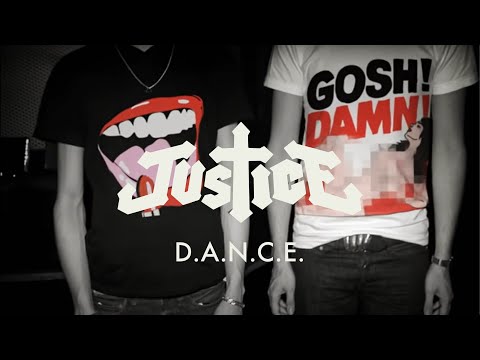
“D.A.N.C.E.” was the single a shimmering, joyful track with children’s choir vocals spelling out the letters of the word dance, with references to Michael Jackson woven through the lyrics. It was indie club anthem and pop crossover simultaneously. “Genesis” was the statement: eight and a half minutes of escalating, overwhelming electronic rock that felt like a cathedral collapsing in slow motion.
A decade later, Justice told Vice that Paris was once again the center of the electronic universe thanks to Cross just as it had been a decade earlier when Daft Punk released Homework. Two moments, two decades, two French acts. The pattern holds.
Ed Banger Records: The Coolest Label in the World (2007)
Justice were the centerpiece of Ed Banger Records, the Paris label founded by Pedro Winter known as Busy P who had been Daft Punk’s manager from 1996 to 2008. The label’s roster in its peak years read like a dream team of French electronic music: Justice, Uffie, SebastiAn, Mr. Oizo, DJ Mehdi, and Cassius.
Ed Banger was not just a label it was a visual universe, defined by the graphic design work of So Me, whose cut-and-paste, Polaroid-camera aesthetic became as recognizable as the music itself. The label operated on a logic of musical hybridity: finding the common ground between Franz Ferdinand and Diplo, between the stadium and the club. It was the most exciting address in music for three years.
The Complete Justice Discography
Everything You Need to Know About Justice
Justice on YouTube
Watch official Justice music videos and stay updated with their latest releases on YouTube.