Alejandro Guerrero Venezuelan Percussionist Based in Paris — Rhythm That Travels Without Losing Its Roots

Alejandro Guerrero — Venezuelan Percussionist in Paris
Alejandro Guerrero is a Venezuelan percussionist currently based in Paris, France. His musical story begins not with drums but with a trumpet: at the age of 12 he joined his high school music band and spent the next five years developing a foundational musical ear, a sense of rhythm, and a love of performance that would never leave him.
Before he turned 20, he made a decision that would define his life: he sought out Carlos “Nené” Quintero, Venezuela’s most celebrated percussionist, and became his student. This was not a small thing. Quintero is widely regarded as the master of Venezuelan percussion, inventor of the Baticonga, and a musician who has shared the stage with Eros Ramazzotti, Celia Cruz, Barry White, and Gato Barbieri. Being accepted as his student was an affirmation and a challenge simultaneously.
Alongside his percussion training, Alejandro deepened his theoretical foundations by studying music theory and composition with Alex Rodriguez “El Marciano”, a prominent Venezuelan musician and composer. Together these two men became not only his teachers but, as he has said himself, his father figures in music.
Since settling in Paris, Alejandro has expanded his musical horizons by embracing diverse global rhythms and collaborating with artists from Venezuelan pop to French folk, Cameroonian music, Caribbean jazz, and everything in between. Paris has given him access to one of the world’s most diverse musical ecosystems — and he has used it fully.
His philosophy is straightforward and demanding: being a musician requires constant study and an endless search for experiences that contribute to both personal and professional growth. Every collaboration is a classroom. Every stage is a lesson. That attitude is visible in the range of artists he has played with — from Latin Grammy winners to French chanson acts to world music ensembles.
His Teachers: Nené Quintero & El Marciano
Carlos “Nené” Quintero
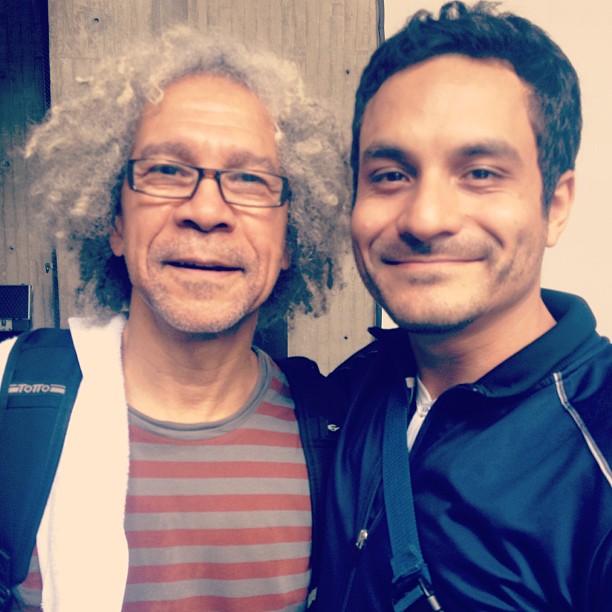
Meeting Carlos “Nené” Quintero before the age of 20 was the defining event of Alejandro’s musical life. Quintero is not just Venezuela’s most respected percussionist — he is the inventor of the Baticonga, a percussionist who spent decades performing internationally alongside Eros Ramazzotti, Celia Cruz, Barry White, Jovanotti, Gato Barbieri, and Little Louie Vega. He is a figure who reshaped what Venezuelan percussion could be and mean.
Studying under him meant learning not just technique but philosophy: how to listen, how to serve the music, how to adapt without losing your own voice. Quintero’s approach to percussion has always been about color — the idea that each strike should contribute a sonic and emotional dimension, not merely a beat. That idea lives in Alejandro’s playing.
“I consider myself fortunate to have studied with these accomplished musicians, not only for the knowledge they imparted but also for the life experiences they shared. I regard both men as my teachers and father figures in my musical development.”
Alex Rodriguez “El Marciano”
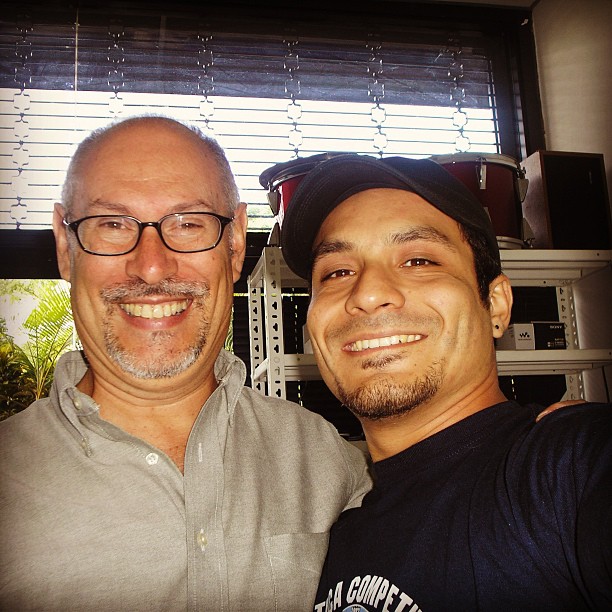
Alex Rodriguez “El Marciano” is a celebrated Venezuelan musician and composer who brought the theoretical dimension to Alejandro’s training. While Quintero shaped his hands, El Marciano shaped his mind — music theory, harmony, arrangement, and the understanding of how rhythms fit into broader musical structures. A percussionist who can compose and arrange is a different kind of collaborator from one who only keeps time.
Together Quintero and El Marciano gave Alejandro a complete musical education: the instinct and the intellect, the body and the mind, the rhythm and the architecture. That dual foundation is precisely what makes him adaptable across so many musical contexts.
“Being a musician requires constant study and an endless search for experiences that contribute to both personal and professional growth.”
— Alejandro GuerreroInstruments & Style
Alejandro’s percussion style is deeply rooted in the rich rhythmic traditions of Venezuela — a tradition that combines indigenous, African, and European influences into something irreducible and alive. The drums he plays span the full range of Latin and world percussion, adapted to whatever musical context he is in.
What distinguishes Alejandro’s approach is not just the range of instruments he commands but the way he listens. Trained by Quintero to understand percussion as color — as a contributor to emotional and sonic texture, not just timekeeping — he brings a compositional sensibility to live playing. Each performance is a conversation with the other musicians, not a fixed part.
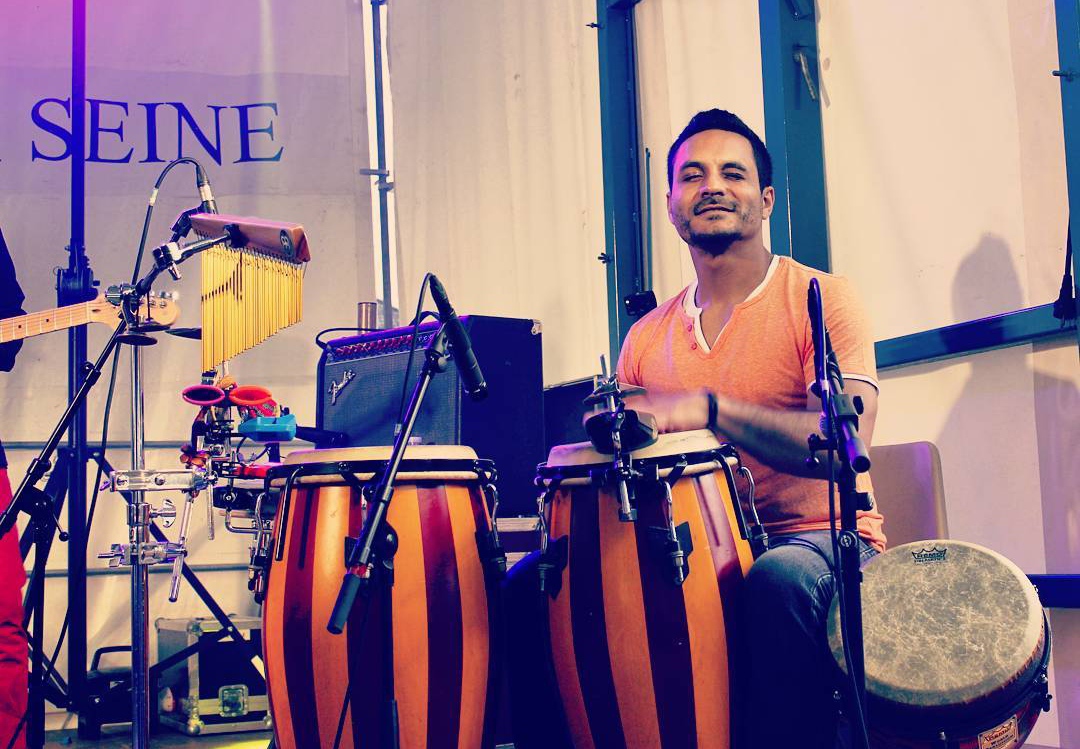
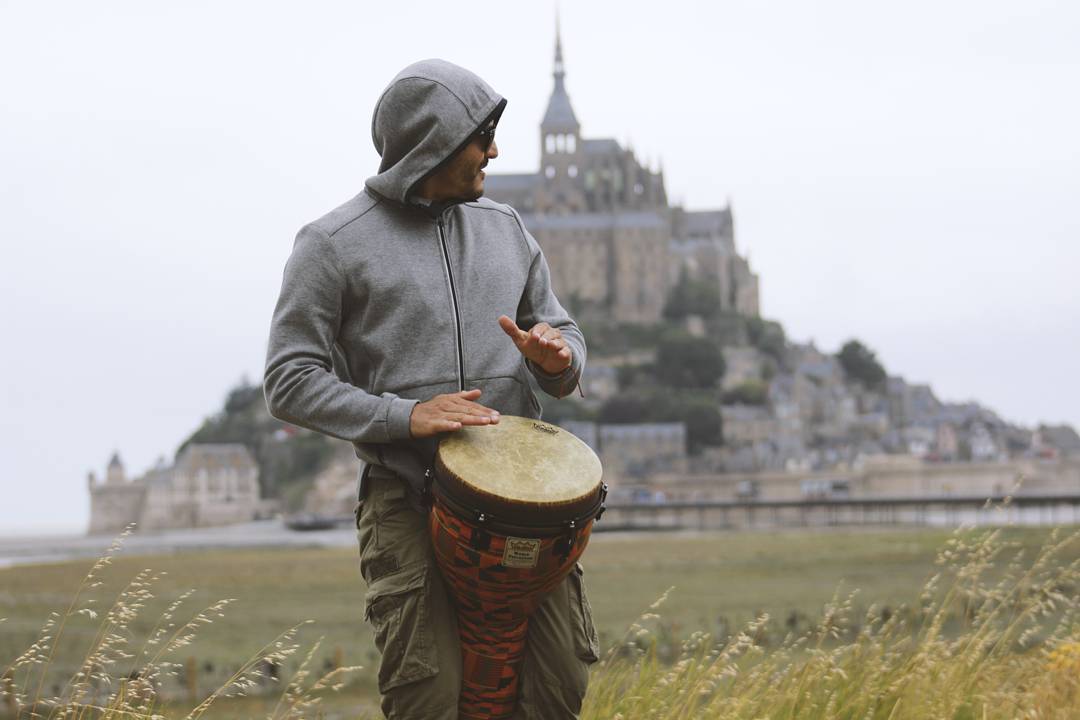
Since moving to Paris he has also embraced djembe, frame drums, and other world percussion elements, expanding his palette further through the rich multicultural music scene the city offers. He has played in settings ranging from intimate jazz clubs to large festival stages, from studio sessions for Latin pop albums to live shows with French folk bands.
Collaborations
Alejandro Guerrero’s career spans three continents and three musical worlds: the Latin American scene he was born into, the international stages he crossed, and the French music ecosystem he now calls home. The variety of artists he has worked with is a testament to how completely he has mastered the art of musical adaptation.
Notable Moments
| Artist | Origin | Context |
|---|---|---|
| Chino y Nacho | Venezuela | Latin Grammy Winners — Venezuela’s most beloved reggaeton duo |
| Ilegales | Dominican Republic | Latin Grammy Winners |
| Jorge Villamizar | Colombia | Latin Grammy Winner — singer songwriter and former member of Bacilos |
| Rember Duarte | Cuba | Live session work |
| Zoufris Maracas | France | French folk and chanson collective — multiple live collaborations |
| Jacky Kingué | Cameroon / France | African and world music crossover |
| Victor Drija | Venezuela | Venezuelan pop artist |
| Enrique Divine | Venezuela | Studio and live percussion |
| Jean-Pierre Marcellesi | France | Collaboration in France |
| Fanny Seï | France | Studio collaboration |
| M.A.S Música / Inspiration Live Music | France | Regular live performance partners |
Among Alejandro’s collaborators are artists with direct Latin Grammy recognition: Chino y Nacho (Venezuela), Ilegales (Dominican Republic), and Jorge Villamizar (Colombia). Performing with artists at that level reflects both his technical caliber and his reputation in the Latin music world.
Live Performances
These recordings capture Alejandro in action across a range of musical contexts — from multipercu showcases to sessions with French folk acts and Caribbean jazz musicians.
MultiPercu
MultiPercu showcase — Paris
Libertad
With Zoufris Maracas
Zoufris Maracas — Live 1
Zoufris Maracas — Live 2
Zoufris Maracas — Live 3
With Rember Duarte — Cuba
With M.A.S Música — Poinciana
Alejandro Guerrero with M.A.S Música — “Poinciana”
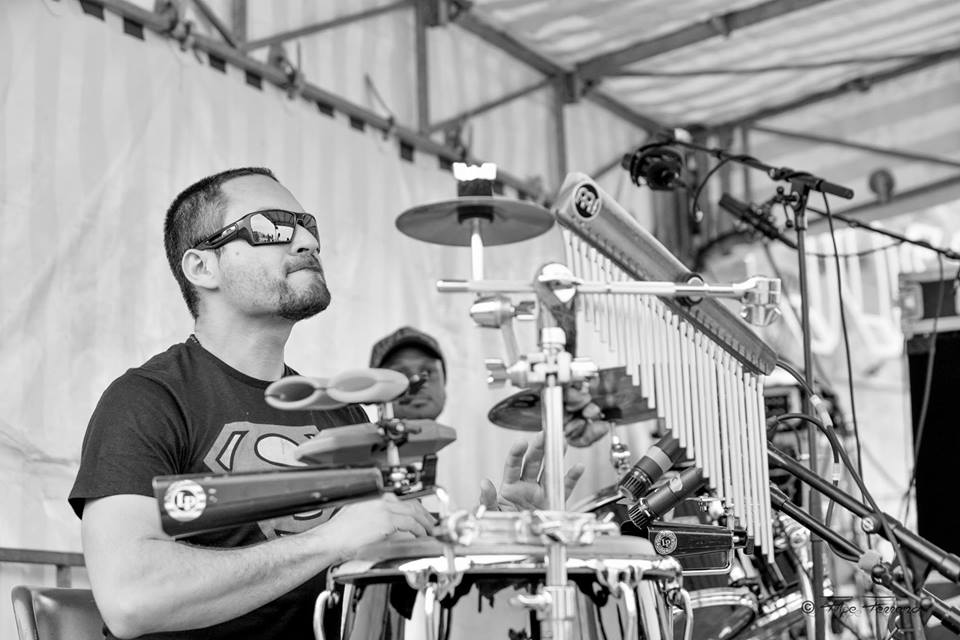
Photo Gallery

Frequently Asked Questions
Alejandro Guerrero is a Venezuelan percussionist based in Paris, France. He began musical training on trumpet at age 12, then dedicated himself to percussion after studying under Carlos Nené Quintero, Venezuela’s most respected percussionist. He has since built a career across three continents.
His two main teachers were Carlos Nené Quintero — Venezuela’s foremost percussionist and inventor of the Baticonga — and Alex Rodriguez “El Marciano”, a Venezuelan musician and composer who taught him music theory and harmony. He regards both as teachers and father figures.
Among others: Chino y Nacho (Latin Grammy Winners, Venezuela), Ilegales (Latin Grammy Winners, Dominican Republic), Jorge Villamizar (Latin Grammy Winner, Colombia), Zoufris Maracas (France), Rember Duarte (Cuba), and Jacky Kingué (Cameroon / France).
Congas, bongos, timbales, cajón, quitiplás, culo e puya (Venezuelan folk percussion), djembe, and a range of world percussion instruments depending on the project.
He is based in Paris, France, where he performs regularly across the French and international music scene. He is originally from Venezuela.
Venezuelan Percussion Lives in Paris Discover More Artists at France Music
Follow Alejandro on Instagram and explore more global sounds.