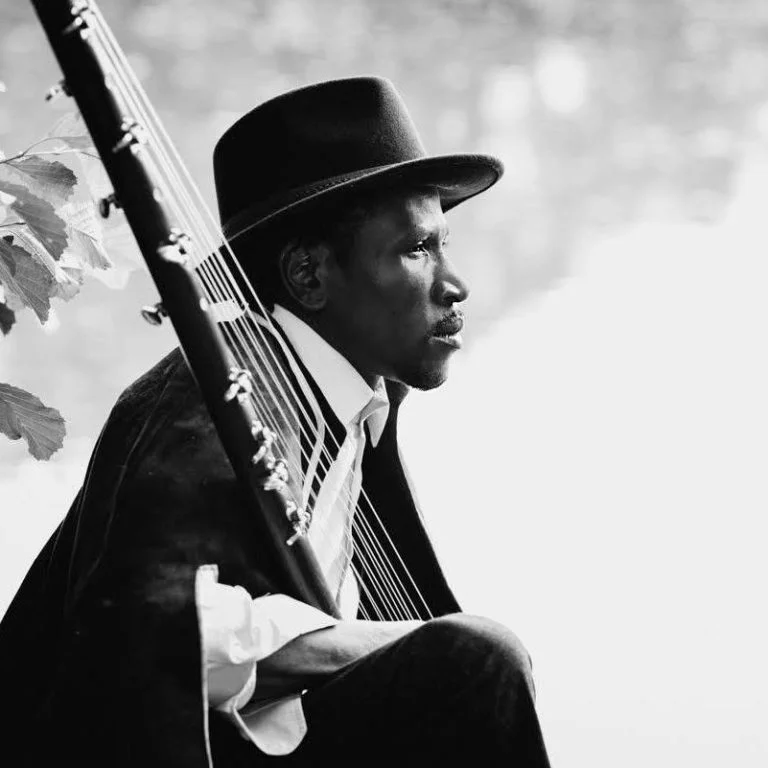
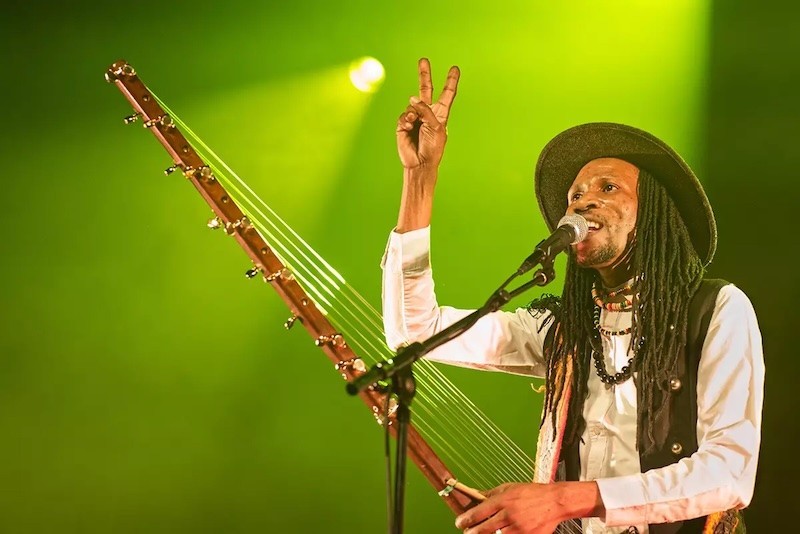
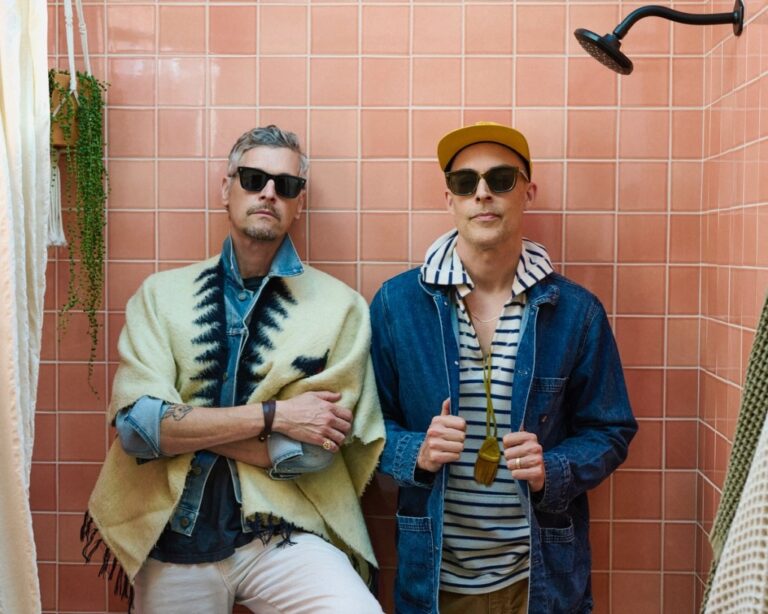
Abou Diarra is a Malian musician, singer and kamele n’goni virtuoso from the Ganadougou area of the Sikasso region in southern Mali, widely recognized as one of the most original voices in contemporary African music. Born in 1975, he grew up in the Wassoulou region, an area in southern Mali considered one of the cradles of West African blues and traditional Mandingo hunter culture.
He is known internationally as the “N’Goni Jimi Hendrix” — a nickname earned through his radical reimagining of an ancient instrument. Where the kamele n’goni has traditionally been played within strict pentatonic conventions, Diarra modified his instrument by adding extra strings, expanding its sonic range and allowing him to use it simultaneously as a guitar, bass, harp and percussion instrument.
From the ancestral culture of the Mandingo hunters: Diarra’s roots in the Wassoulou region are inseparable from his music. The donso n’goni — the hunter’s lute — was the instrument of his ancestors before the kamele n’goni appeared. This lineage runs through every note he plays, connecting his contemporary world music fusion to centuries of West African tradition.
After spending years in Mali learning from master players, he walked across West Africa on foot, collected musical traditions from remote villages and modern cities, settled in France in 2008, and has since established himself as a leading ambassador of Malian music on the international stage. His live band, the Donko Band, consists of established musicians from West Africa who share his passion for Mandingo music, African blues and groove.
The Origin Story
The Walk That Made Him: Abidjan to Bamako on Foot
Abou Diarra’s path to becoming a musician was unlike any other. His first teacher was Vieux Kanté, also known as “Sans Commentaire,” a virtuoso kamele n’goni player who was blind — a musician whose mastery was so complete that his visual impairment became irrelevant. Diarra studied under Kanté for years, beginning in 1999 in Bamako, and continued until Kanté’s death in 2005.
But before Bamako, there was the walk. For several months, Diarra traveled the roads between Abidjan (Ivory Coast), Bamako (Mali) and Conakry (Guinea) — on foot, accompanied only by his n’goni. He was not touring. He was listening. Passing through remote villages and modern cities alike, he absorbed hidden traditional sounds alongside contemporary urban music. This pilgrimage with his instrument as sole companion was not just a physical journey but a complete musical education.
This period gave his music its defining characteristic: the sense of travel, exile, and movement. Every album Abou Diarra has made carries the memory of that walk — the dust of Malian roads, the sounds collected in village ceremonies and urban nightclubs, the meeting point of ancient and contemporary West Africa.
The Instrument
The Kamele N’Goni: What It Is and How Diarra Transformed It
The kamele n’goni (also written ngoni or n’goni) is a traditional West African string instrument, sometimes described as a Malian harp-guitar. It belongs to the lute family and is tuned to a pentatonic scale (Bambara tradition), distinguishing it from the kora which uses a diatonic scale. The donso n’goni — the hunter’s n’goni — came first historically, used by Mandingo hunters in ceremonies; the kamele n’goni came later and has become the instrument most associated with the Wassoulou region.
The N’Goni: Key Facts
Type
West African lute-harp (string instrument)
Tuning
Pentatonic scale (Bambara tradition)
Origin
Mali, Wassoulou region (Mandingo hunters)
Diarra’s modification
Extra strings added — expands range beyond classical scale
How Diarra plays it
As guitar, bass, harp and drum simultaneously
Nickname earned
“The N’Goni Jimi Hendrix”
Diarra’s relationship with the instrument goes beyond playing it. He also builds his own n’goni by hand, using traditional techniques with no power tools. A video on his YouTube channel documents this process in full — one of the most striking illustrations of his connection to the instrument as both musician and craftsman.
Abou Diarra — Building a Kamele N’Goni by hand (no power tools)
The Music
Musical Style: Where Mali Meets Blues, Jazz and Reggae
Abou Diarra’s music is built on a paradox: it is deeply rooted in the traditions of Wassoulou and Mandingo culture, and simultaneously open to the entire world. He describes himself as fascinated by blues, jazz, reggae, and groove — the rhythms and styles in which different countries, sounds and influences come together. This fascination drove his long walk across West Africa and continues to drive his music today.
In practice, this means his albums fuse the n’goni’s distinctive pentatonic sound with jazz harmonics, blues guitar sensibility, African percussion, and contemporary production. His voice alternates between raw, powerful delivery and quieter, more intimate passages. His concerts, performed with the Donko Band, create what his label described as “the acoustics of the n’goni strings, the roundness of the Malian sun, the suave beat of urban praises and the poetic urgency of movement.”
Key Collaborations
One of the most celebrated moments in Diarra’s career was his collaboration with Toumani Diabaté, the legendary Malian kora player, on two tracks from the Koya album (2016): “Djarabi” and “Labanko”. These recordings combined two of Mali’s most ancient instruments — the kora and the n’goni — in a way that moved critics and audiences alike. Toumani Diabaté, one of the most important figures in world music history, died on 19 July 2024 in Bamako at age 58, making these recordings a precious final document of his genius.
Diarra has also performed alongside American jazz trombonist Roswell Rudd, and his producer for the Sabou album (2013) was Eric Bono, a sound engineer who had previously worked with Youssou N’Dour, Mory Kanté and Alpha Blondy.
Watch
Abou Diarra: Official Videos and Live Performances
Abou Diarra feat. Toumani Diabaté — “Djarabi” (Official Music Video, from Koya 2016)
His most celebrated international release. Features the landmark collaboration with kora legend Toumani Diabaté on “Djarabi” and “Labanko.” Includes “Koya Blues” and “Yakouba,” blending African rhythms with blues and jazz. Released internationally on 10 November 2016, promoted with a concert at the New Morning in Paris on 2 February 2017.
A live recording capturing the energy and intensity of Diarra’s concert performances. Features “Mali Sadio,” a track celebrating the beauty of his homeland, and demonstrates the full power of the Donko Band in a live setting. New Morning is one of Paris’s most celebrated world music venues.
A powerful collection exploring themes of journey and identity. Produced by Eric Bono, a sound engineer who had previously worked with Youssou N’Dour, Mory Kanté and Alpha Blondy. Features accordion, violin and drums alongside the n’goni. Diarra specifically chose not to rehearse with the accordion player — the spontaneity was deliberate.
Subtitled “Sans Commentaire” in homage to his teacher Vieux Kanté (whose nickname was Sans Commentaire). Recorded in France after his first visits in 2008. The album that established Diarra in the French world music scene and earned him festival slots across Europe. Available on Discogs for full track listing.
The debut record that first brought Abou Diarra to international attention. Released the year after his teacher Vieux Kanté died in 2005, marking the beginning of his solo career. The album that proved his approach to the n’goni was not merely technical innovation but a complete artistic vision.
Diarra has appeared as a featured artist on recordings with Toumani Diabaté (kora, Mali — died July 2024), Roswell Rudd (jazz trombone, USA), and various West African and European musicians. These collaborations extend the reach of the n’goni into jazz, blues and contemporary world music contexts.
Born in Ganadougou in the Sikasso region of southern Mali, into the ancestral culture of the Mandingo hunters. From childhood he accompanies his mother to ceremonies and traditional festivals where the n’goni is central.
1990s
The Walk: Abidjan to Bamako on foot
For several months Diarra walks the roads between Abidjan (Ivory Coast), Bamako (Mali) and Conakry (Guinea) with only his n’goni. He absorbs traditional music from remote villages and contemporary sounds from modern cities. This journey defines his musical identity.
1999
Meets Vieux Kanté in Bamako
Arrives in Bamako and meets Vieux Kanté, known as “Sans Commentaire,” a blind virtuoso n’goni master widely recognized across Mali and internationally. Diarra becomes his student.
2005
Vieux Kanté dies
The death of his master marks the end of his formal apprenticeship and the beginning of his solo career. Diarra names his second album “An Ka Belebele — Sans Commentaire” in direct homage to Kanté’s memory.
2006
Debut album: Kono Kan Bora
Releases his first album, gaining initial recognition in Mali and across West Africa. Establishes his reputation as a breakthrough artist appearing in charts, radio shows and interviews across the region.
2008
First European tour; settles in France
Invited to France for concerts and workshops around the kamele n’goni. Charmed by the country, he returns in 2010 and eventually establishes Paris as his European base, participating in festivals across France and the continent.
2016
Koya released — featuring Toumani Diabaté
His most acclaimed international release. The collaboration with kora legend Toumani Diabaté on “Djarabi” and “Labanko” is widely celebrated. Concert at the New Morning in Paris to promote the album.
2024
Death of Toumani Diabaté
Toumani Diabaté, Diarra’s collaborator on Koya and one of the greatest figures in world music history, dies on 19 July 2024 in Bamako at age 58. Their recordings together on “Djarabi” and “Labanko” become even more precious documents of his genius.
FAQ
Everything About Abou Diarra
Who is Abou Diarra? +
Abou Diarra is a Malian musician and singer born in 1975 in the Sikasso region of southern Mali. He is a virtuoso player of the kamele n’goni, a traditional West African string instrument, and is internationally known as the “N’Goni Jimi Hendrix” for his radical innovations with the instrument. He has been based in Paris since 2008 and is one of the leading ambassadors of Malian music in the international world music scene.
What is the n’goni? +
The n’goni (or kamele n’goni) is a traditional West African string instrument from Mali, similar to a lute or harp. It is tuned to a pentatonic scale and has its roots in the Mandingo hunting culture of the Wassoulou region. Abou Diarra modified his n’goni by adding extra strings, expanding its range and allowing him to play it as a guitar, bass, harp or percussion instrument simultaneously.
Why is Abou Diarra called the N’Goni Jimi Hendrix? +
Abou Diarra earned the nickname “N’Goni Jimi Hendrix” because of his radical, boundary-breaking approach to the n’goni. Just as Jimi Hendrix transformed what the electric guitar could do, Diarra transformed what the n’goni could do: he added extra strings to expand its range beyond the classical pentatonic scale, and he uses it to replace a guitar, bass, harp and drum simultaneously. His technical virtuosity and willingness to push the instrument far beyond its traditional role earned him this comparison.
What albums has Abou Diarra released? +
Abou Diarra has released four studio albums: Kono Kan Bora (2006, debut), An Ka Belebele (2010), Sabou (2013), and Koya (2016). He also released a live album, Live au New Morning (2015), recorded at the famous Paris world music venue. All albums are available on Spotify. Koya is his most internationally celebrated work, featuring a collaboration with Toumani Diabaté.
Did Abou Diarra collaborate with Toumani Diabaté? +
Yes. Abou Diarra collaborated with kora legend Toumani Diabaté on two tracks from his 2016 album Koya: “Djarabi” and “Labanko.” Both tracks combine the kora and the n’goni in a way that drew widespread critical praise. Toumani Diabaté died on 19 July 2024 in Bamako at age 58, making these recordings a particularly significant part of his final legacy.
Where can I see Abou Diarra live? +
Abou Diarra performs regularly at world music festivals across France and Europe with his Donko Band. Check his Instagram (@ngoniabou), his YouTube channel, and platforms like Bandsintown for upcoming concert dates. He has performed at major venues including the New Morning in Paris and at festivals across France, Germany, Belgium and beyond.